2002AMC10B真题与答案解析

2002AMC10B真题
答案解析请参考文末
Problem 1
The ratio  is:
is:

Problem 2
For the nonzero numbers  and
and  define
![[(a,b,c)=frac{abc}{a+b+c}]](https://latex.artofproblemsolving.com/b/7/d/b7d4bd262608a0dd797bcb05f438a96915733a5f.png) Find
Find  .
.

Problem 3
The arithmetic mean of the nine numbers in the set  is a
is a  -digit number
  , all of whose digits are distinct. The number does not contain the digit

Problem 4
What is the value of
![[(3x-2)(4x+1)-(3x-2)4x+1]](https://latex.artofproblemsolving.com/f/b/c/fbc3f0bbfadfdaaf435e500728b6d72792d26174.png)
when  ?
?

Problem 5
Circles of radius  and
and  are externally tangent and are circumscribed by a third circle, as shown in the figure. Find the area of the shaded region.
![[asy] unitsize(5mm); defaultpen(linewidth(.8pt)+fontsize(10pt)); dotfactor=4; real r1=3; real r2=2; real r3=5; pair A=(-2,0), B=(3,0), C=(0,0); pair X=(1,0), Y=(5,0); path circleA=Circle(A,r1); path circleB=Circle(B,r2); path circleC=Circle(C,r3); fill(circleC,gray); fill(circleA,white); fill(circleB,white); draw(circleA); draw(circleB); draw(circleC); draw(A--X); draw(B--Y); pair[] ps={A,B}; dot(ps); label("$3$",midpoint(A--X),N); label("$2$",midpoint(B--Y),N); [/asy]](https://latex.artofproblemsolving.com/2/c/5/2c5a7bbafa30af5c988825a58d564ad2037aaa7b.png)

Problem 6
For how many positive integers  is
is  a prime number?

Problem 7
Let be a positive integer such that  is an integer. Which of the following statements is not true?

Problem 8
Suppose July of year  has five Mondays. Which of the following must occur five times in the August of year ? (Note: Both months have
  days.)

Problem 9
Using the letters  , ,
, ,  ,
,  , and
, and  , we can form five-letter "words". If these "words" are arranged in alphabetical order, then the "word"
  occupies position

Problem 10
Suppose that  and
and  are nonzero real numbers, and that the equation
  has solutions and . what is the pair
  ?
?

Problem 11
The product of three consecutive positive integers is  times their sum. What is the sum of their squares?

Problem 12
For which of the following values of  does the equation
  have no solution for
  ?
?

Problem 13
Find the value(s) of such that  is true for all values of
  .
.

Problem 14
The number  is the square of a positive integer . In decimal representation, the sum of the digits of is

Problem 15
The positive integers ,  ,
,  , and
, and  are all prime numbers. The sum of these four primes is

Problem 16
For how many integers is  the square of an integer?

Problem 17
A regular octagon  has sides of length two. Find the area of
  .
.

Problem 18
Four distinct circles are drawn in a plane. What is the maximum number of points where at least two of the circles intersect?

Problem 19
Suppose that  is an arithmetic sequence with
![[a_1+a_2+cdots+a_{100}=100 text{ and } a_{101}+a_{102}+cdots+a_{200}=200.]](https://latex.artofproblemsolving.com/e/8/6/e868a80b5058466bd743a2b7b66cb8c2f25c7447.png) What is the value of
What is the value of 

Problem 20
Let and  be real numbers such that
  and
and  Then
Then  is
is

Problem 21
Andy's lawn has twice as much area as Beth's lawn and three times as much as Carlos' lawn. Carlos' lawn mower cuts half as fast as Beth's mower and one third as fast as Andy's mower. If they all start to mow their lawns at the same time, who will finish first?

Problem 22
Let  be a right-angled triangle with
  . Let and be the midpoints of the legs
  and
and  , respectively. Given
  and
and  , find
  .
.

Problem 23
Let  be a sequence of integers such that
  and
and  for all positive integers
  and
and  Then
Then  is
is

Problem 24
Riders on a Ferris wheel travel in a circle in a vertical plane. A particular wheel has radius  feet and revolves at the constant rate of one revolution per minute. How many seconds does it take a rider to travel from the bottom of the wheel to a point
  vertical feet above the bottom?

Problem 25
When  is appended to a list of integers, the mean is increased by . When
  is appended to the enlarged list, the mean of the enlarged list is decreased by . How many integers were in the original list?

2002AMC10B详细解析
 or
or 

- We wish to find
 , or
, or  . This does not have the digit 0, so the answer is
  Notice that the final number is guaranteed to have the digits
  and that each of these digits can be paired with an even number adding up to 9. can be taken out, with the other digits fulfilling divisibility by 9.
 ![$(3x-2)[(4x+1)-4x] + 1 = 3x-2 + 1 = 3x-1 = 3(4) - 1 = boxed{mathrm{(D)} 11}$](https://latex.artofproblemsolving.com/a/a/0/aa01f3de68b8e5cb8901b61622119f3327d4c7e0.png) .
.- A line going through the centers of the two smaller circles also go through the diameter. The length of this line within the circle is
 Because this is the length of the larger circle's diameter, the length of its radius is
  The area of the large circle is
  , and the area of the two smaller circles is
  To find the area of the shaded region, subtract the area of the two smaller circles from the area of the large circle.
- Factoring, we get
 . Either
  or
or  is odd, and the other is even. Their product must yield an even number. The only prime that is even is , which is when is . The answer is
  .Considering parity, we see that
  is always even. The only even prime is , and so
  whence
  .
. - Since
 ,
,![[0 < lim_{n rightarrow infty} left(frac{41}{42} + frac{1}{n}right) < frac {41}{42} + frac 1n < frac{41}{42} + frac 11 < 2]](https://latex.artofproblemsolving.com/0/a/1/0a117286e3f8f0f84a7cbc59b1204f101146fc51.png) From which it follows that
From which it follows that  and
and  . The only answer choice that is not true is
  .
. - If there are five Mondays, there are only three possibilities for their dates:
 ,
,  , and
, and  .In the first case August starts on a Thursday, and there are five Thursdays, Fridays, and Saturdays in August.In the second case August starts on a Wednesday, and there are five Wednesdays, Thursdays, and Fridays in August.In the third case August starts on a Tuesday, and there are five Tuesdays, Wednesdays, and Thursdays in August.The only day of the week that is guaranteed to appear five times is therefore
  .
. - There are
 "words" beginning with each of the first four letters alphabetically. From there, there are
  with as the first letter and each of the first three letters alphabetically. After that, the next "word" is , hence our answer is
  .Let
.Let  . Then counting backwards,
  , so the answer is
- Since
 , it follows by comparing coefficients that
  and that
  . Since is nonzero,
  , and
, and  . Thus
  .Another method is to use Vieta's formulas. The sum of the solutions to this polynomial is equal to the opposite of the coefficient, since the leading coefficient is 1; in other words,
  and the product of the solutions is equal to the constant term (i.e,
  ). Since is nonzero, it follows that and therefore (from the first equation),
  . Hence, Note that for roots and , . This implies that is , and there is only one answer choice with in the position for , hence,
 - Let the three consecutive positive integers be
 , , and
  . So,
. So,  .
.  , so
, so  . Hence, the sum of the squares is
  .
. - The domain over which we solve the equation is
 .We can now cross-multiply to get rid of the fractions, we get
  .Simplifying that, we get
  . Clearly for
  we get the equation
  which is never true. The answer is
  For other , one can solve for :
  , hence
  . We can easily verify that for none of the other four possible values of is this equal to or
  , hence there is a solution for in each of the other cases.
 - We have
 .As
.As  must be true for all , we must have
  , hence
  .Since we want only the -variable to be present, we move the terms only with the -variable to one side, thus constructing to
  . For there to be infinite solutions for and there is no , we simply find a value of such that the equation is symmetrical. Therefore,
 There is only one solution, namely
  or
or 
- Taking the root, we get
 .Now, we have
  .Combining the 's and
  's gives us
  .This is the number
  with a string of sixty-four
  's at the end. Thus, the sum of the digits of is
- Since and must have the same parity, and since there is only one even prime number, it follows that and are both odd. Thus one of
 is odd and the other even. Since
  , it follows that (as a prime greater than ) is odd. Thus
  , and
, and  are consecutive odd primes. At least one of is divisible by , from which it follows that
  and
and  . The sum of these numbers is thus
  , a prime, so the answer is
  .In order for both
  and
and  to be prime, one of must be 2, or else both , would be even numbers.If
  , then
  and
and  , which is not possible. Thus .Since is prime and
  , we can infer that
  and thus can be expressed as
  for some natural number .However in either case, one of and can be expressed as
  which is a multiple of 3. Therefore the only possibility that works is when
  and
and![[A + B + (A - B) + (A + B) = 5 + 2 + 3 + 7 = 17]](https://latex.artofproblemsolving.com/0/0/9/009d79e62fcb86d45c7d973d181b0c3b8d45bb69.png) Which is a prime number.
Which is a prime number. 
- Let
 , with
  (note that the solutions
  do not give any additional solutions for ). Then rewriting,
  . Since
  , it follows that
  divides . Listing the factors of , we find that
  are the only
  solutions (respectively yielding
  ).For
).For  and
and  the fraction is negative, for
  it is not defined, and for
  it is between 0 and 1.Thus we only need to examine
  and
and  .For and
  we obviously get the squares and respectively.For prime the fraction will not be an integer, as the denominator will not contain the prime in the numerator.This leaves
  , and a quick substitution shows that out of these only
  and
and  yield a square. Therefore, there are only solutions (respectively yielding ).If
  , then
  and
and  , otherwise will be negative. Thus
  and
and![[0 = frac{0}{20-(0)} le frac{n}{20-n} le frac{19}{20-(19)} = 19]](https://latex.artofproblemsolving.com/9/f/e/9feb430d115aea0e9e86b02cdd2ae225b49642b5.png) Checking all for which
Checking all for which  , we have , , , as the possibilities.
- The area of the triangle
 can be computed as
  . We will now find
  and
and  .Clearly,
  is a right isosceles triangle with hypotenuse of length , hence
  . The same holds for triangle
  and its leg
  . The length of
  is equal to
  . Hence
  , and
, and  .Then the area of equals
  .
. - For any given pair of circles, they can intersect at most times. Since there are
 pairs of circles, the maximum number of possible intersections is
  . We can construct such a situation as below, so the answer is
  .
.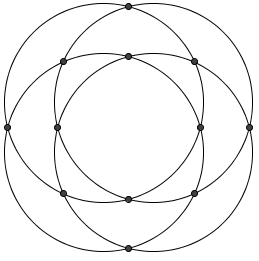 Because a pair or circles can intersect at most times, the first circle can intersect the second at points, the third can intersect the first two at
  points, and the fourth can intersect the first three at points. This means that our answer is
  Pick a circle any circle- ways. Then, pick any other circle- ways. For each of these circles, there will be intersections for a total of
  =
=  intersections. However, we have counted each intersection twice, so we divide for overcounting. Therefore, we reach a total of
  , which corresponds to .
 - We should realize that the two equations are 100 terms apart, so by subtracting the two equations in a form like...
 ...we get the value of the common difference of every hundred terms hundred times. So we have to divide the answer by hundred to get ...
 ...the common difference of every hundred terms. Then we have to simply divide the answer by hundred again to find the common difference between one term, therefore...

Adding the two given equations together gives
 .
.Now, let the common difference be
 . Notice that
  , so we merely need to find to get the answer. The formula for an arithmetic sum is
 ,
,where
 is the first term, is the number of terms, and is the common difference. Now we use this formula to find a closed form for the first given equation and the sum of the given equations. For the first equation, we have
  . Therefore, we have
 ,
,or
 . *(1)
For the sum of the equations (shown at the beginning of the solution) we have
 , so
, so
or
 *(2)
*(2)Now we have a system of equations in terms of
and . Subtracting (1) from (2) eliminates , yielding  , and
, and  .
.Subtracting the 2 given equations yields

Now express each
 in terms of first term and common difference between consecutive terms
Simplifying and canceling
and terms gives


- Rearranging, we get
 and
and  Squaring both,
  and
and  are obtained.Adding the two equations and dividing by
  gives
gives  , so
, so  .The easiest way is to assume a value for and then solving the system of equations. For , we get the equations
 and
and
Multiplying the second equation by
, we have
Adding up the two equations yields
 , so
, so 
We obtain
 after plugging in the value for .
Therefore,
 which corresponds to
  .
. - We say Andy's lawn has an area of . Beth's lawn thus has an area of
 , and Carlos's lawn has an area of
  .We say Andy's lawn mower cuts at a speed of . Carlos's cuts at a speed of
  , and Beth's cuts at a speed
  .Each person's lawn is cut at a speed of
  , so Andy's is cut in
  time, as is Carlos's. Beth's is cut in
  , so the first one to finish is
  .
. 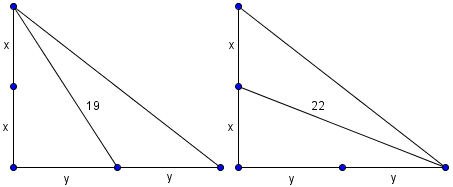 Let
Let  ,
,  . By the Pythagorean Theorem on
  respectively,
 Summing these gives
  .By the Pythagorean Theorem again, we have
![[(2x)^2 + (2y)^2 = XY^2 Longrightarrow XY = sqrt{4(x^2 + y^2)} = sqrt{4(169)} = sqrt{676} = boxed{mathrm{(B)} 26}]](https://latex.artofproblemsolving.com/f/1/6/f16445ea2f3d51273e055db6c290c3f43c9d12d2.png) Alternatively, we could note that since we found
Alternatively, we could note that since we found  , segment
  . Right triangles
  and
and  are similar by Leg-Leg with a ratio of
  , so
, so 
- When
 ,
,  . Hence,
![[a_{2}=1+a_1+2]](https://latex.artofproblemsolving.com/8/9/6/89690c735df48656e99be995bfc1b51ae9309078.png)
![[a_{3}=1+a_2+3]](https://latex.artofproblemsolving.com/6/2/5/62550c6c9a0eaad755a6e3c025445f1f6d4cf158.png)
![[a_{4}=1+a_3+4]](https://latex.artofproblemsolving.com/e/3/3/e33fbf139288a9b2002a876b9b63c0b60966385f.png)
![[dots]](https://latex.artofproblemsolving.com/1/6/7/16762e47f22f53e2431935f211fa82570b46b6cb.png)
![[a_{12}=1+a_{11}+11]](https://latex.artofproblemsolving.com/1/a/0/1a0b1067f595a8c0e8a661368a8ca69a9a568797.png) Adding these equations up, we have that
Adding these equations up, we have that  ~AopsUser101Substituting
  into
into  :
:  . Since
  ,
,  . Therefore,
  , and so on until
  . Adding the Left Hand Sides of all of these equations gives
  ; adding the Right Hand Sides of these equations gives
  . These two expressions must be equal; hence
  and
and  . Substituting :
  . Thus we have a general formula for
  and substituting
  :
:  .We can literally just plug stuff in. No prerequisite is actually said in the sequence. Since
  , we know
  . After this, we can use
  to find
  .
.  . Now, we can use and to find
  , or
, or  . Lastly, we can use to find .
- We can let this circle represent the ferris wheel with center
 and
and  represent the desired point feet above the bottom. Draw a diagram like the one above. We find out
  is a
is a  triangle. That means
  and the ferris wheel has made
  of a revolution. Therefore, the time it takes to travel that much of a distance is
  of a minute, or seconds. The answer is
  . Alternatively, we could also say that
  is congruent to by SAS, so
  is 20, and
  is equilateral, and
 - Let be the sum of the integers and be the number of elements in the list. Then we get the equations
 and
and  . With a lot of algebra, the solution is found to be
  .
.
We let be the original number of elements in the set and we let be the original average of the terms of the original list. Then we have  is the sum of all the elements of the list. So we have two equations:
![[mn+15=(m+2)(n+1)=mn+m+2n+2]](https://latex.artofproblemsolving.com/6/6/b/66b21d1fbe8f4cc78d1eb0fcc195630b089938aa.png) and
and![[mn+16=(m+1)(n+2)=mn+2m+n+2.]](https://latex.artofproblemsolving.com/a/f/4/af4fbe178484847c58081846dad4c976910bd24d.png) Simplifying both equations and we get,
Simplifying both equations and we get,![[13=m+2n]](https://latex.artofproblemsolving.com/5/f/1/5f1613bc612071685ebd46c8791690ac0b36dfb6.png)
![[14=2m+n]](https://latex.artofproblemsolving.com/8/5/e/85e9e11be3059a8465cea31baf18907be815086f.png) Solving for and , we get
Solving for and , we get  and
and  .
.
Warning: This solution will rarely ever work in any other case. However, seeing that you can so easily plug and chug in probem 25 it is funny to see this.
Plug and chug random numbers with the answer choices, starting with the choice of numbers. You see that if you have 4 5s and you add 15 to the set, the resulting mean will be 7; we can verify this with math![[frac{5+5+5+5+15}{5}=7]](https://latex.artofproblemsolving.com/5/0/a/50a7de715e5f84e8a3554c87d5e927175af30d9a.png) adding in 1 to the set you result in the mean to be 6.
adding in 1 to the set you result in the mean to be 6.![[frac{5+5+5+5+15+1}{6}=6]](https://latex.artofproblemsolving.com/3/4/4/34441527a8923a2e71f54494f79e108743910c9c.png) Thus we conclude that 4 is the correct choice or
Thus we conclude that 4 is the correct choice or 
以上解析方式仅供参考
学术活动报名扫码了解!免费领取历年真题!

翰林AMC8视频课重磅上线!

国际竞赛真题资源免费领取







